
The Power of Iteration
What a heron taught me
Claude Monet was never satisfied with his art because it didn’t match the vision in his head. If that’s how you feel too, then you’re in good company!
Monet was frustrated to the point of despair in his attempts to paint the light falling on his subjects, a light that changed all day long, and season by season. He created more than 250 paintings of water lilies, over 30 canvases of the Rouen Cathedral, and 25 versions of haystacks. Monet was intrigued by the effect that different weather conditions and lighting had on his subject. Trying to capture the ever-changing light, he felt compelled to paint many versions. Monet was a master at iteration.
I finally appreciate the power of iteration after painting multiple versions of a heron perched on a sailboat. And yes, I am comparing myself to Monet! We are both artists. We are both frustrated by our inability to capture the beauty of nature as we perceive it. And we both feel compelled to keep trying!
Iteration is an integral part of the creative process. To iterate means to repeat a painting or a poem or any creative work, revising, adjusting, and experimenting until you get the results you are looking for.
Holding on too tightly to those desired results comes at a very high cost, though. So often, we create a thing, a painting or a poem, and expect perfection. Disappointment follows. And maybe we walk away from it. But there are wonders that happen when you iterate.
I hate to admit that just starting can be a challenge. I often need some kind of inspiration or plan to begin the creative process. I almost always start in my head.
Once I’ve begun, I encounter a host of competing thoughts: I want a certain outcome. Like Monet, I want my art to capture the vision in my head. And, what is also true is that I want to let my artist soul take the lead. How slowly I am learning that when I allow my head to direct the painting process, the result may be technically accurate but it feels lifeless. Allowing my artist soul or my intuition to direct the process can lead to more exciting outcomes.
Being open to the leading of your soul is to dance with mystery.
In the words of artist Enrique Martinez Celaya, who co-authored Tending the Fire: Creativity, Purpose, and the Unfolding Self with James Hollis:
I do not begin with complete knowledge of what a painting, a book, or a project will become. If I did, there would be no reason to undertake it. The process itself is an act of discovery, guided by intuition and responsiveness. This requires a willingness to enter into uncertainty without resisting it. Too much certainty flattens the work -- makes it elegant and sophisticated at best, but ultimately, a confirmation of what I already understood. The unknown, on the other hand, is a force just out of reach that keeps the work alive.
Consider what can occur when you allow art to be a process of exploration. Holding onto outcomes loosely (or not at all) can lead to discovering new ways of combining colors, using tools, approaching composition, or new substrates or materials. All of these can lead to things you didn’t already know but only if you are open.
Come along with me through my iterations on this piece to see what the heron taught me! Here’s where we started. My friend Robyn Steele sent me this fabulous photo. I told her that I wanted to paint it — I do love herons. They remind me of my mother because I saw one ascending right after her funeral mass. I chose to interpret that as evidence of her soul ascending to heaven. So whenever I see a heron, I think of her.
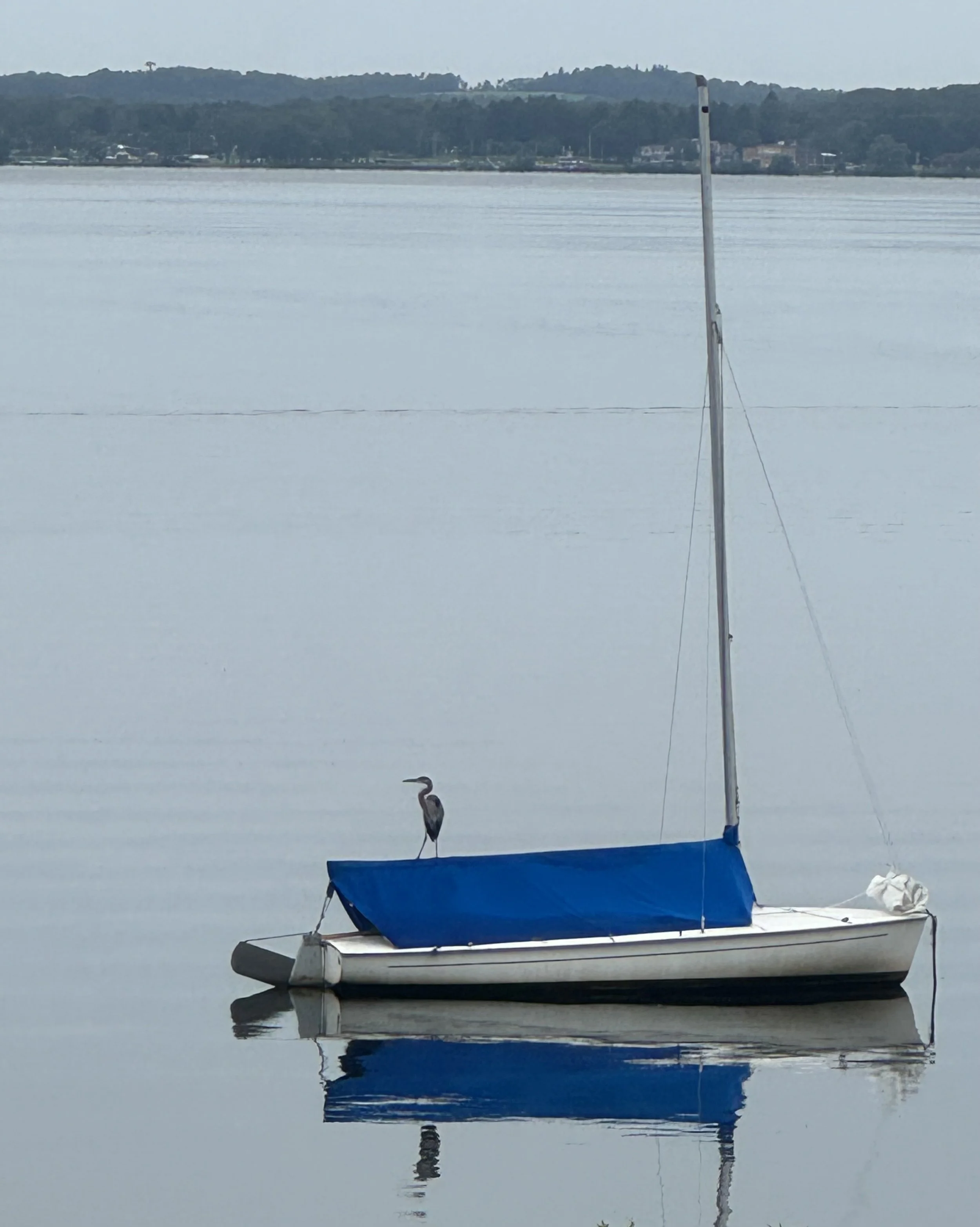
Heron watching from sailboat by Robyn Steele
Now that I had a plan, I created a pencil sketch to settle on the arrangement of the elements and the proportions. Careful measuring of the mast and the heron kept me from making the heron a giant!
photo sketch
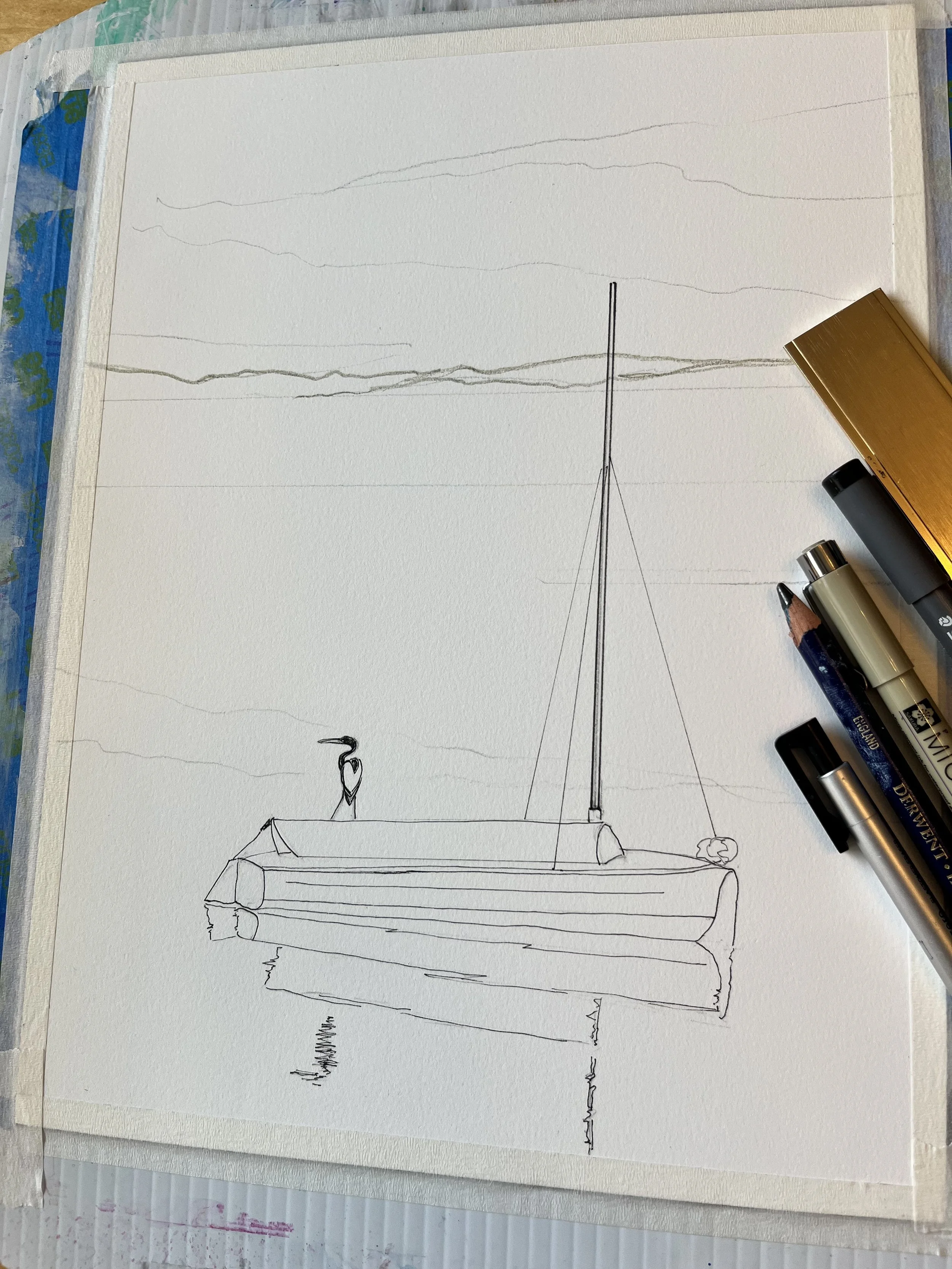
sketch of heron perched on sailboat
My first iteration, staying true to the inspiration photo:
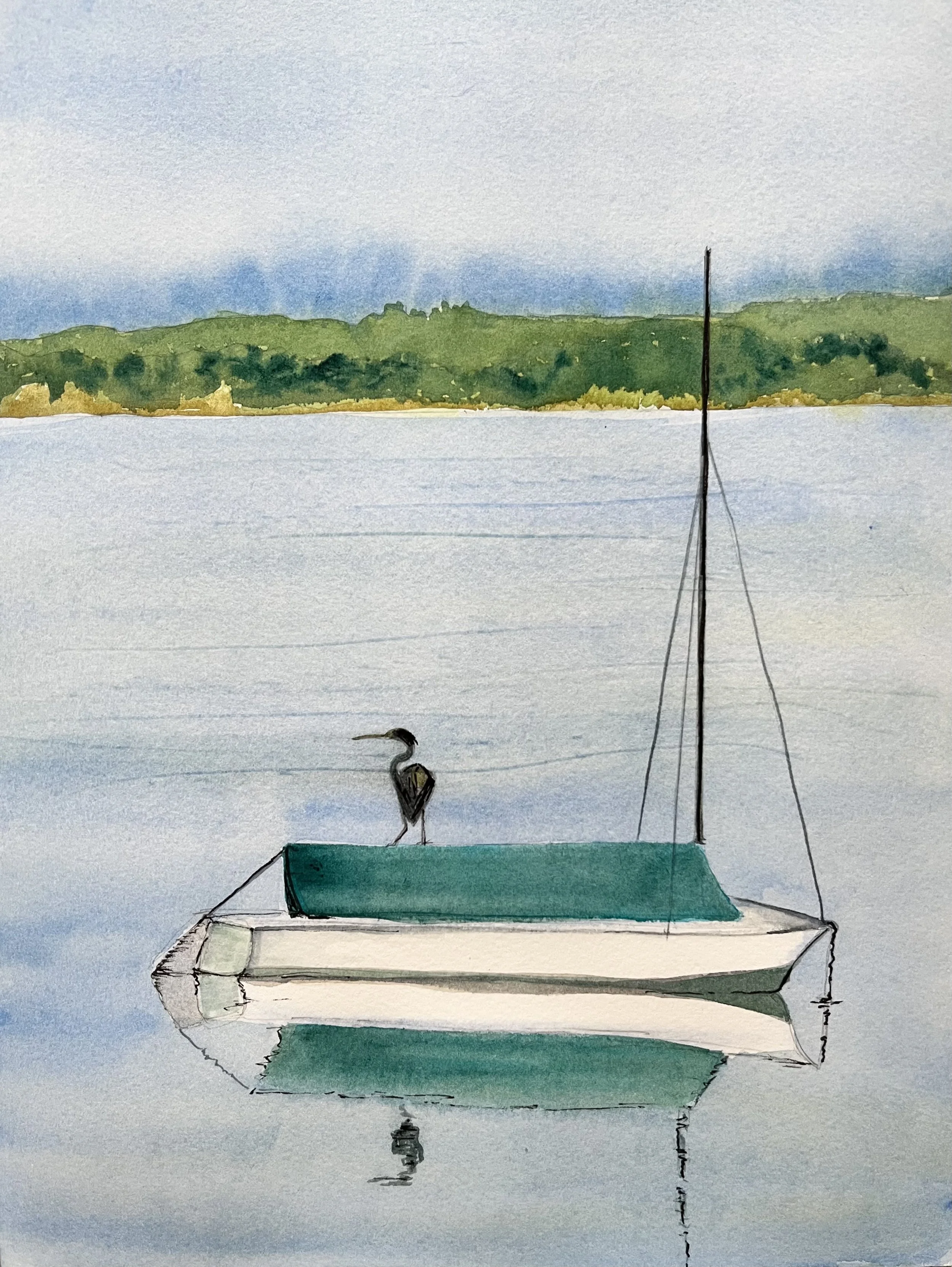
my first watercolor version of the Heron Watching
In my next iteration, I wondered about combining this subject matter (heron on boat) with a bright orange sky at sunset. Using watercolors for this entire series gave me the opportunity to play with clouds made from watercolor blooms. Blooms happen when you add water or more paint to an already painted area that is still damp. Blooms are difficult to control! Some artists love them and some artists hate them.
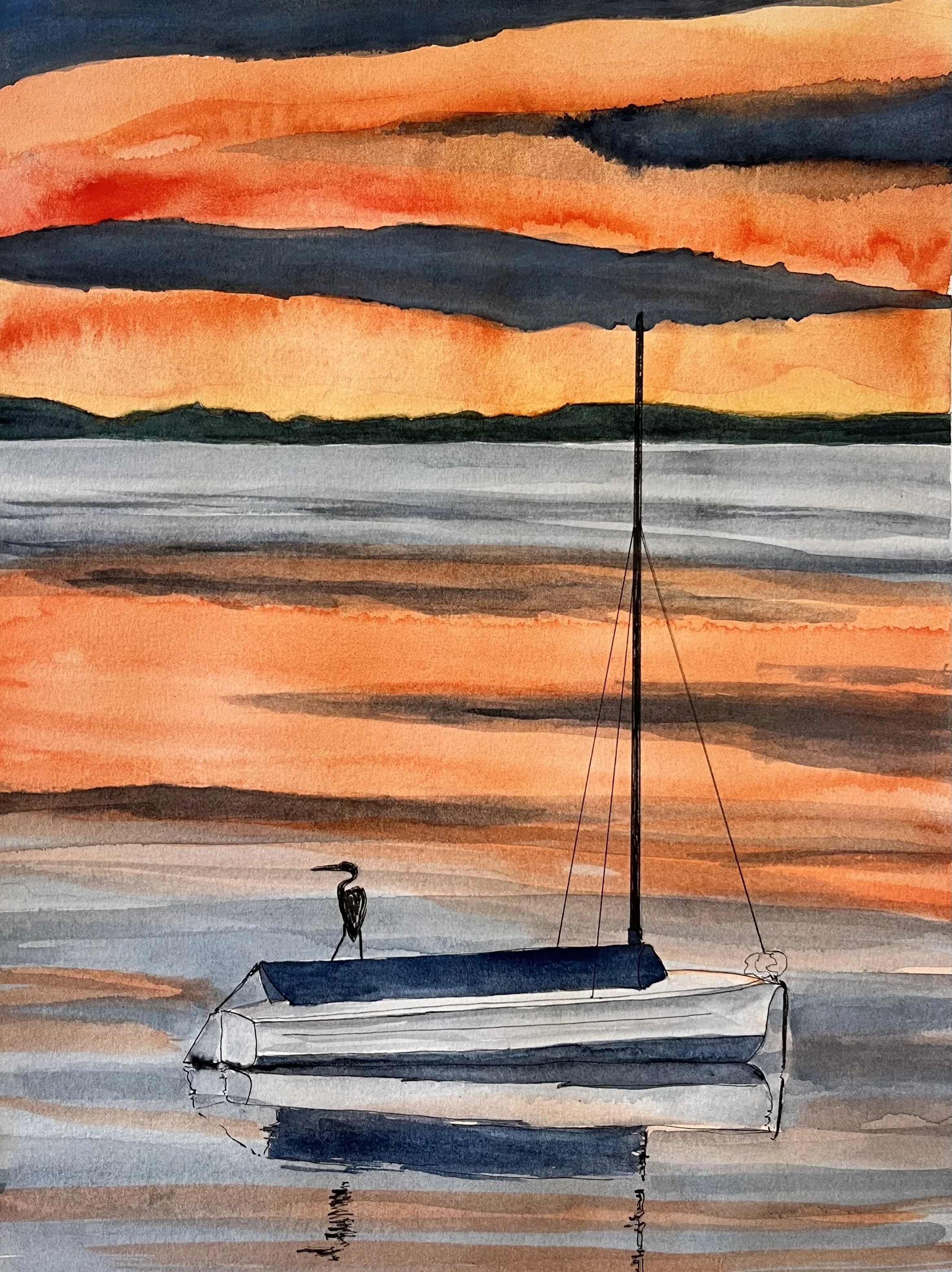
I love them so I wanted to use this technique to portray an orange sky. After the orange paint was dry, I added dark blue clouds. Here is a progress picture showing how I left white spaces for the horizon line, the blue clouds and the boat and then a picture of a sunset iteration:
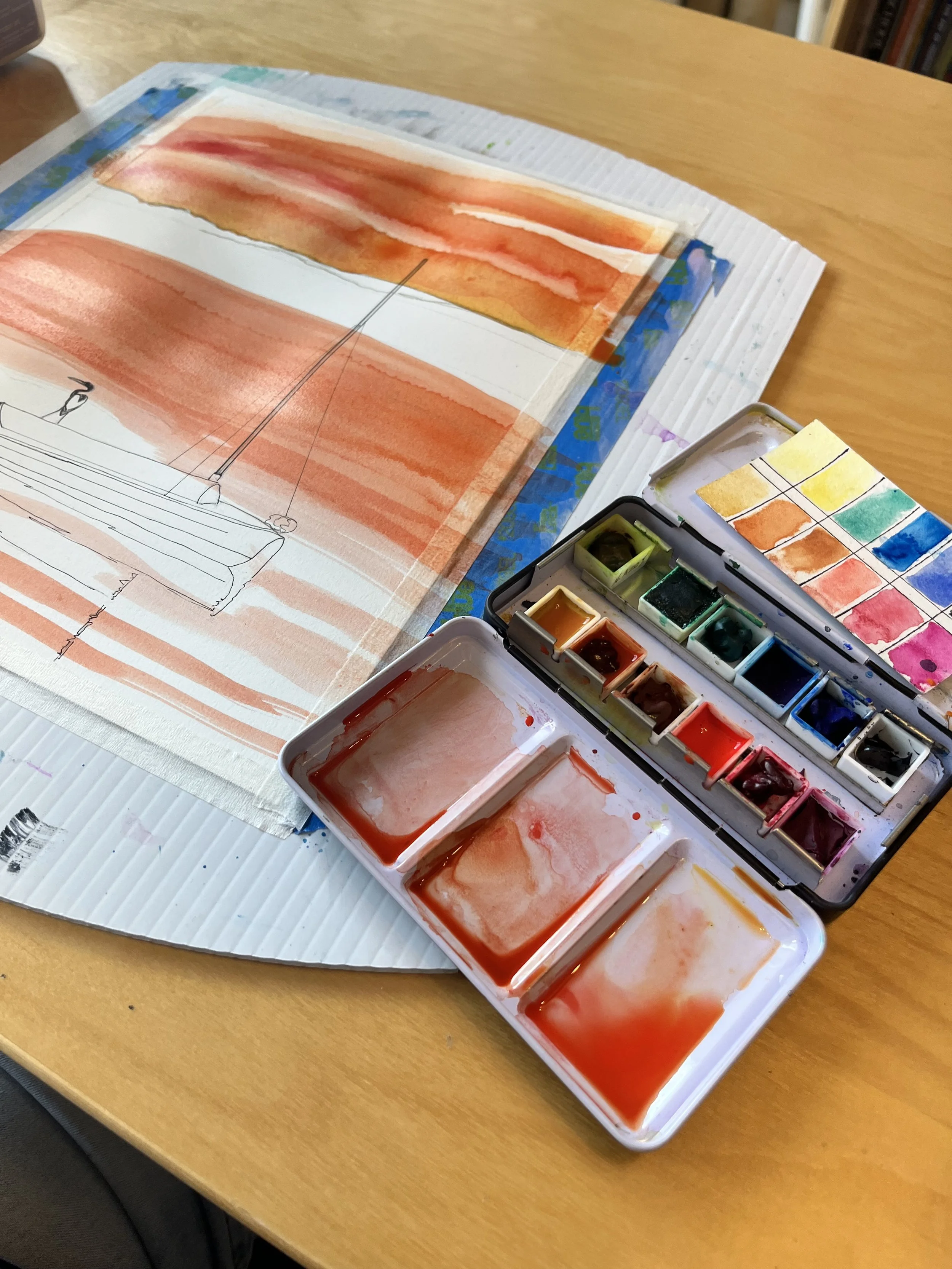
Beginning with a wet-on-wet orange sky
First iteration with orange and blue clouds
I liked the orange blooms in the sky and as reflected in the water but the dark blue clouds seemed too static, their edges too hard.
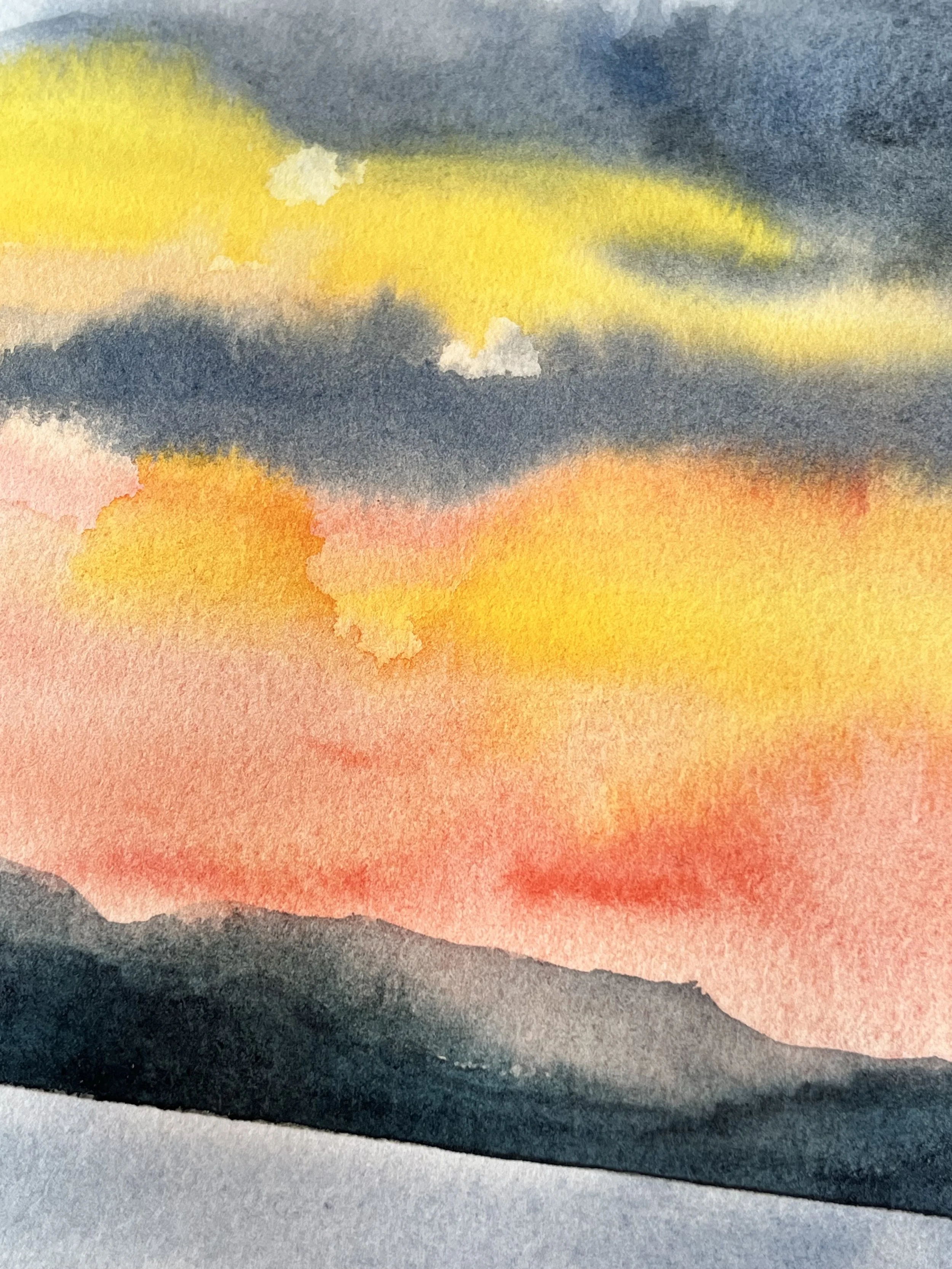
My next iteration resulted from me asking my favorite question: “What would happen if I …” used the wet-on-wet technique for both the orange sky and the blue clouds? Would the colors blend and turn muddy? Or would the edges be softer and more cloud-like?
Before beginning a new piece, sketching out the boat and all, I tested my idea of wet-orange-on-wet-blue technique on a separate piece of watercolor paper. I didn’t even bother to tape off the edges that give it a crisp edge. I painted in the horizon line/far side of the lake after the blue and orange had completely dried. Here is a close-up up of the sky:
Close up of the wet-on-wet with orange and blue watercolor
Love Love Love how that turned out!!
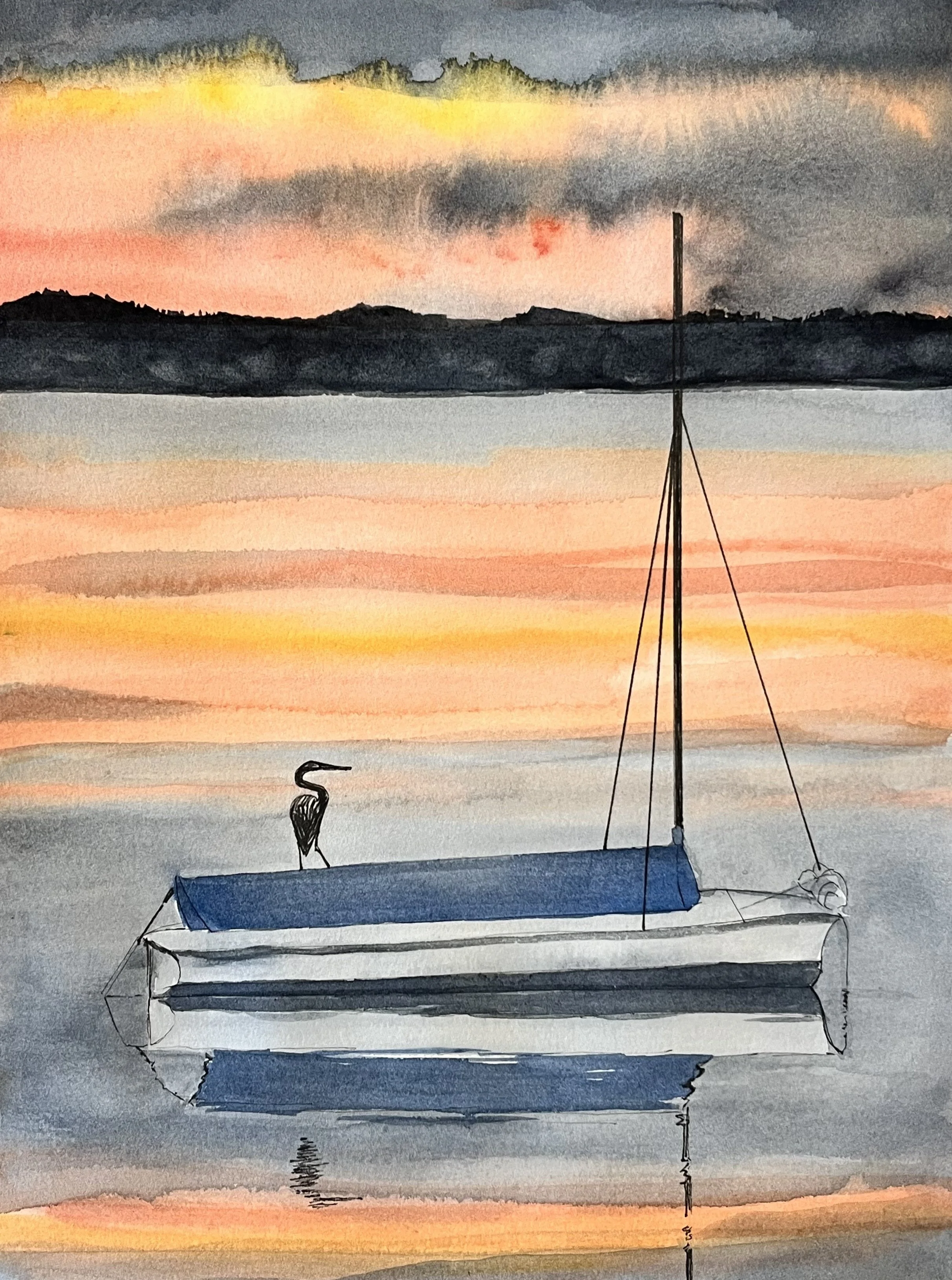
I used the same technique on the next iteration, where I had already sketched the boat out while waiting for the test piece to dry. The blooms in the sky work pretty well, but I would have liked the blooms to be more noticeable in the water’s reflection.
Second iteration of sunset sky using the wet-on-wet technique
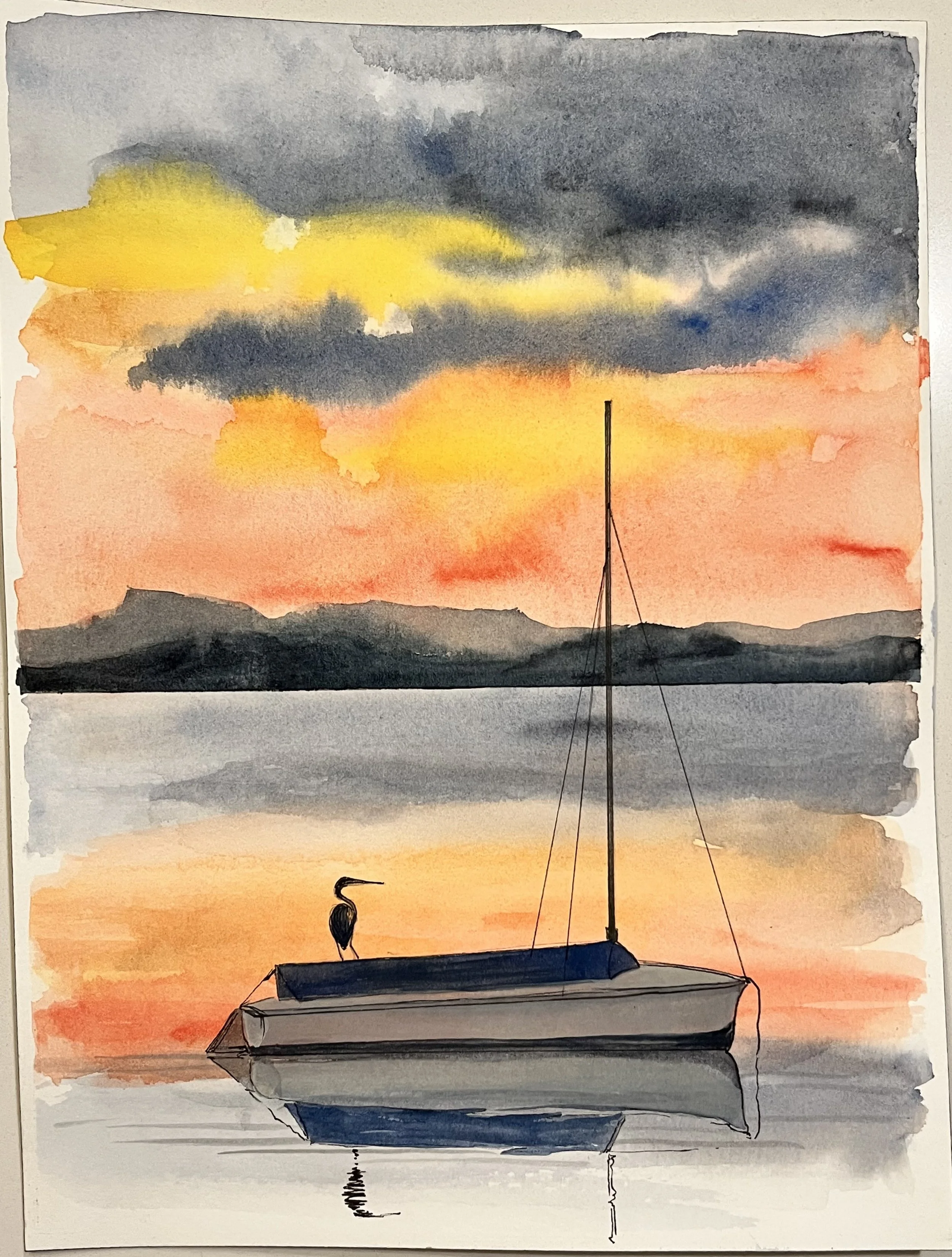
I have to say my test piece turned out to be my favorite. I love the looseness of the clouds and I also like the irregular edges that came from not using masking tape. That irregular edge is proof that the painting was made by a human and not AI! I sketched in the boat and the heron one last time on this fourth iteration. I am very pleased with how they all turned out but this one is my favorite!
I would have never arrived here without all of the iterations!
One of the best parts of being the artist is that you get to use artist license. You get to choose which details matter and which don’t, and you can make as many modifications that you decide serve the painting. When sketching the sailboat, I chose to grab its essence, and not get lost in all the folded sails and ropes. You only need enough detail to let the viewer know that this is a sailboat. If you want all the details, you can use your camera. In addition to changing the entire sky and its reflections in the lake, the other bit of artistic license I took was turning the heron to face the center. Any figure facing out of the picture frame brings the viewer’s eye out of the picture instead of keeping the viewer engaged in the picture.
Final iteration of a loosely painted sunset sky using the wet-on-wet technique
I was most interested in capturing a feeling of calm as night falls on the quiet lake. The heron feels like a silent guardian watching over the lake. Reminds me of a children’s book I still have memorized. “The sun has set not long ago…”
Which iteration is your favorite?